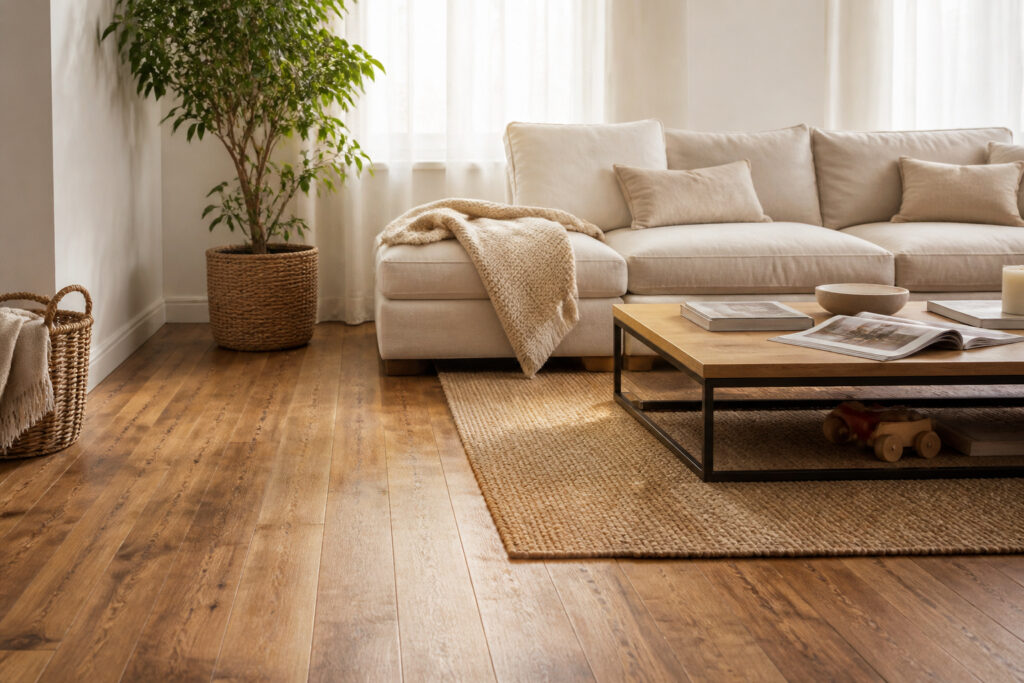
Mirage Floors takes the top spot for one reason: its 0.16 in wear layer gives you enough real wood above the tongue to refinish multiple times, and owners report it holds up in basements and kitchens where moisture ruins lesser boards.
That thickness is only worth paying for if you plan to stay long enough to use it; renters and short-term owners will find the same look for less further down the list.
[link-whisper-related-posts]My Top Picks
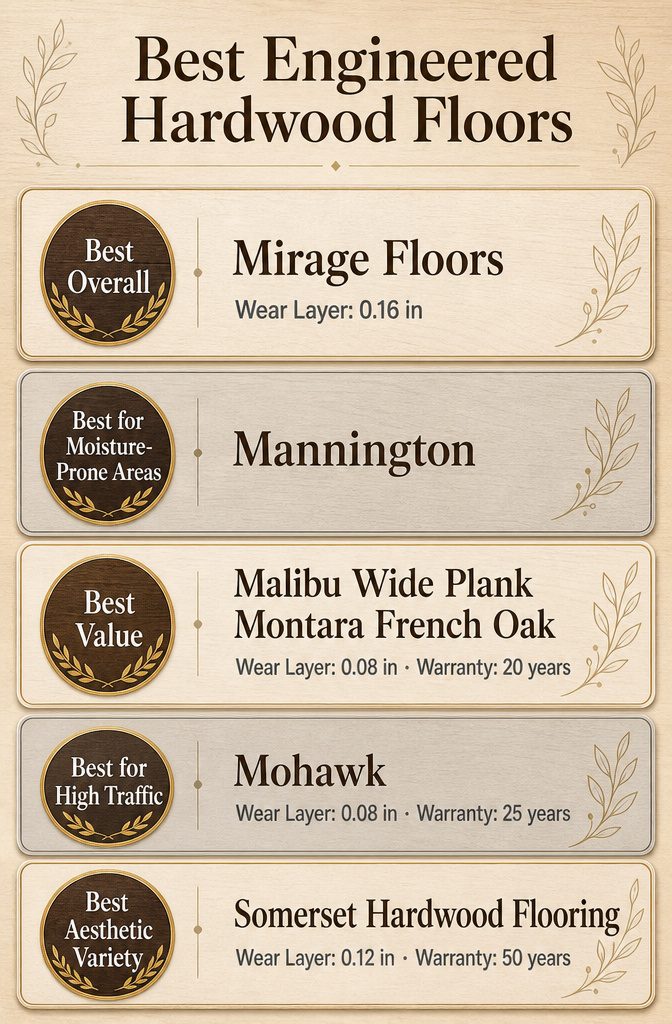
| Product | Award | Best for | Why it won | ||
|---|---|---|---|---|---|
 | Mirage Floors | Best Overall | Buyers wanting balanced performance | Thick wear layer, moisture resistance, and flexible installation methods | Check price |
 | Mannington | Best for Moisture-Prone Areas | Homes with humidity or moisture risks | Stands out for water resistance where other floors would warp or fail | Check price |
 | Malibu Wide Plank Montara French | Best Value | Budget-conscious shoppers | Delivers solid features and looks without the premium price tag | Check price |
 | Mohawk | Best for High Traffic | Busy households with heavy foot traffic | Built tough to withstand daily wear from kids, pets, and constant use | Check price |
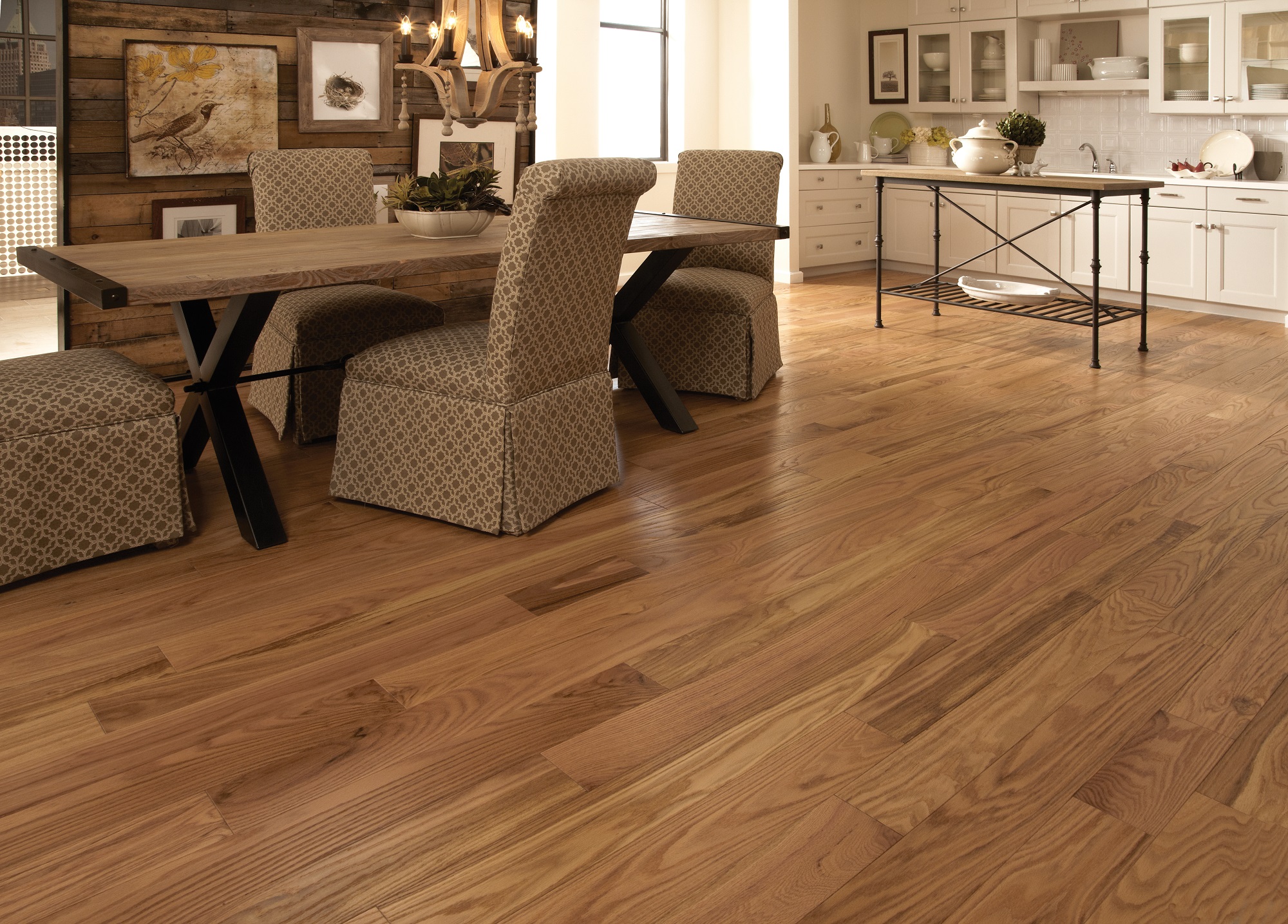 | Somerset Hardwood Flooring | Best Aesthetic Variety | Design-focused buyers wanting options | Wide selection of Appalachian timber styles and finishes to match any room | Check price |
| Product | Wear Layer | Warranty |
|---|---|---|
| Mirage Floors | 0.16 in | — |
| Mannington | — | — |
| Malibu Wide Plank Montara French | 0.08 in | 20 years |
| Mohawk | 0.08 in | 25 years |
| Somerset Hardwood Flooring | 0.12 in | 50 years |
Best Overall: Mirage Floors
Quick Verdict
If you are looking for one engineered hardwood line that handles almost every room and install situation without asking you to compromise on air quality or future refinishing, Mirage Floors is the place I would start.
The 0.16 in wear layer gives you enough wood above the tongue to sand down later, and owners report that the boards hold up in kitchens and basements where moisture sends other products back to the store.
The real weakness is the premium positioning; this is not the line for a tight budget refresh.
Key Specifications
- Wear Layer: 0.16 in
What It Does Well
- Thick wear layer for its class. The 4 mm veneer means you can refinish the surface multiple times over decades, which changes the math for buyers who plan to stay put.
- Moisture resistance that expands where you can install it. Owners and independent reviewers note that Mirage works in basements and kitchens, so you are not forced to switch to vinyl or tile for those rooms.
- Three install methods from one box. Glue-down, nail-down, or floating: the flexibility matters if you are renting and want to float it now, or if you later move to a home with plywood subfloors.
- FloorScore-certified finishes. The low-VOC certification is a concrete check on indoor air quality, not a marketing claim, which matters for nurseries or anyone with sensitivities.
Where It Falls Short
- Premium pricing. The maker and retailers position Mirage at the higher end of the market, so buyers on a strict budget may need to look elsewhere.
- Overbuilt for short-term spaces. If you are refreshing a rental you will leave in two years, the refinishing potential and thick veneer are advantages you will never use.
Who It’s For
Someone furnishing a first home or a long-term rental with their own labor on weekends, who wants one flooring type through the kitchen, living area, and even a below-grade rec room.
A buyer who needs the lowest possible cost per square foot and plans to sell or move soon will not extract the value from this wear layer.
How It Compares
Malibu Wide Plank Montara French Oak sits at a lower price tier with a thinner veneer, which limits how many times you can sand it down the road.
That tradeoff suits a weekend project in a starter home or a room you know you will replace within a decade. Mirage rewards the buyer who wants to install once and refinish later rather than rip out.
Where to buy: Amazon
Best for Moisture-Prone Areas: Mannington
Quick Verdict
If your laundry room or basement has killed every floor you’ve tried, Mannington is the pick that survives the moisture.
The maker rates it fully waterproof and backs it with a lifetime residential warranty, which matters more than brand prestige in rooms that flood or steam.
The real weakness is how little independent evidence exists for its other qualities; you’re buying it for the one thing it demonstrably does, and hoping the rest holds up.
What It Does Well
- 100% waterproof construction. Mannington handles standing water and constant humidity without warping, which lets you install it below grade or next to appliances that vent steam.
- Lifetime residential warranty. The maker’s coverage runs for as long as you own the home, so you’re not recalculating replacement costs on a five-year horizon.
- Style range. Available finishes let it read as wood or stone, so a mudroom doesn’t have to look like a utility space just because the material is practical.
Where It Falls Short
- Thin public record on wear and comfort. Outside the maker’s own claims, there’s not much owner-reported detail on how it feels underfoot or how the surface holds up to dragging appliances.
- Brand reputation gaps. Compared with established names, Mannington has less of a footprint in independent forums and long-term owner reviews, so you’re trusting the warranty more than a crowd of experienced users.
Who It’s For
A renter or first-home owner with a concrete slab bathroom or a kitchen that sees standing water more than once a year can stop worrying about the subfloor.
Someone chasing resale prestige or wanting deep documentation from a decade of owner use will probably gravitate toward a name with more visible history, even if the moisture specs are slightly less aggressive.
How It Compares
Mohawk also fields moisture-resistant engineered hardwood, and owners do report it holding up in humid climates.
The difference is in the noise around the brand: Mohawk draws polarized reviews, with some owners reporting finish wear or customer service friction that Mannington’s quieter profile simply doesn’t have enough volume to confirm or deny.
If you trust a loud crowd and want to sort through complaints to find your answer, Mohawk gives you more to work with.
If you want the maker to promise waterproofing in writing and leave it at that, Mannington’s warranty language is the clearer bet.
Where to buy: Amazon
Best Value: Malibu Wide Plank Montara French
Quick Verdict
Budget-conscious shoppers who need real wood underfoot without the premium markup tend to land here.
The Malibu Wide Plank Montara French Oak brings a genuine oak veneer thick enough to look right, paired with moisture resistance that opens up kitchens and basements where traditional solid hardwood hesitates.
The catch sits in that same veneer: at 0.08 in, refinishing is a one-time event at best, and some owners report the 20-year warranty outlives the floor’s actual lifespan.
Key Specifications
- Wear Layer: 0.08 in
- Warranty: 20 years
What It Does Well
- Wet-room flexibility. The moisture resistance extends installation into kitchens and basements, spaces that often force renters and first-home owners toward lookalike materials.
- Multiple install paths. Different methods suit different skill levels and subfloor conditions; weekend projects don’t all start from the same place.
- Style range. Variety in finishes means less compromise between what the room needs and what the budget allows.
Where It Falls Short
- Thin veneer, limited future. The 2mm wear layer caps refinishing options; once the surface goes, replacement follows sooner than with thicker alternatives.
- Lifespan questions. Independent reviewers note the 20-year warranty may overstate practical durability, with some owners seeing wear that suggests a shorter timeline.
Who It’s For
A renter or first-home owner doing one hands-on project a year, working within a tight weekend window, finds the moisture resistance and install options forgiving.
Someone planning to stay put for decades and counting on multiple refinish cycles should look past the oak veneer to thicker wear layers; the 0.08 in here decides against them.
How It Compares
Mohawk’s engineered hardwood runs lower in cost and carries its own durability and moisture-resistance credentials, though owner reports split sharply on quality and consistency.
The Malibu suits buyers who want the oak species itself and prefer Home Depot’s delivery infrastructure; Mohawk attracts those prioritizing the lowest entry point and willing to sort through mixed feedback to find a reliable batch.
Where to buy: Amazon
Best for High Traffic: Mohawk
Quick Verdict
High-traffic homes need flooring that can take a beating without looking beaten, and Mohawk’s engineered hardwood earns its place here on that promise alone.
The 0.08 in wear layer gives you something to work with when scratches eventually show, and the 25-year warranty suggests the maker expects it to last.
The noise around the brand is real; some owners report excellent performance, others leave frustrated, so your comfort with that gamble matters as much as the specs.
Key Specifications
- Wear Layer: 0.08 in
- Warranty: 25 years
What It Does Well
- Enough wear layer for real refinishing. At 0.08 in, the surface can be sanded and refinished at least once, which turns a 10-year floor into a 20-year one if you are willing to hire the work out.
- Three install methods. Glue-down, nail-down, or floating: your subfloor condition and your lease terms (or your patience) get to decide, not the product.
- Moisture resistance built in. Engineered construction with moisture design means basements and kitchens are not automatic disqualifiers, though you still need proper prep.
- Eco-friendly certifications included. For buyers tracking indoor air quality or LEED-adjacent goals, the paperwork is already done.
Where It Falls Short
- Reviews run hot and cold. Owners describe sharply different experiences with the same product line, which makes it harder to buy with confidence.
- Style variety can overwhelm. Wide finish and style options sound like freedom until you are three hours into samples and still unsure what ships from stock.
- Warranty terms shift by product. The 25-year figure appears in reports, but verifying your exact SKU is essential; the paperwork does not always match the marketing.
Who It’s For
The buyer who moves furniture twice a year, owns a dog with untrimmed nails, or runs a side business from the dining room and needs the floor to forgive it.
Someone who will not fit here is the perfectionist who needs consensus before clicking buy; the polarized owner reports will grate on you every time a board creaks.
How It Compares
Malibu Wide Plank’s Montara French Oak asks less upfront and gives you the same engineered construction, but its thinner veneer means refinishing is barely an option once the surface goes.
That makes Mohawk the better fit for buyers who plan to stay long enough to wear through the finish, while Malibu suits the five-to-seven-year timeline or the room you are not sure you will keep.
Where to buy: Amazon
Best Aesthetic Variety: Somerset Hardwood Flooring
Image: somersetfloors.com
Quick Verdict
For buyers who want real hardwood without narrowing their vision to a handful of standard stains, Somerset’s range of Appalachian-sourced options is hard to match.
The 50-year wear warranty and 0.12 in wear layer give the planks staying power, and the maker notes the material handles moisture better than solid hardwood and installs on any grade level.
The sustainability story woven through the line may feel like noise to shoppers who just want the look.
Key Specifications
- Wear Layer: 0.12 in
- Warranty: 50 years
What It Does Well
- Appalachian timber sourcing opens up grain and color range that generic domestic lines rarely cover; owners describe finding exactly the tone their older home needed without custom ordering.
- 3 mm wear layer thickness means the surface can be refinished down the road, extending the floor’s life past the first decade.
- Any-grade installation removes the basement question that trips up traditional hardwood buyers; your lower level is not automatically ruled out.
Where It Falls Short
- Sustainability messaging dominates the brand story, which independent reviewers say can obscure practical details for shoppers who care more about performance than origin.
- "More resistant to moisture than solid hardwood" still means wood, not waterproof; owners in humid climates report managing expectations, not ignoring humidity entirely.
Who It’s For
A buyer restoring a 1920s bungalow or building a cohesive look across split-level rooms will find enough variety to stay out of the custom-order lane.
Someone hunting purely by durability spec or wanting to float a floor over concrete without reading moisture charts first will likely stall on the care requirements.
How It Compares
Mannington’s Adura line trades the refinishing option for waterproof vinyl construction, which suits buyers who need a basement laundry room or mudroom floor that can take standing water.
Somerset keeps the real wood feel and the long-term sanding option, so the choice splits on whether your weekend project is about authentic material or about never thinking about that floor again.
Where to buy: somersetfloors.com
How I Chose the Best Engineered Hardwood Floors
I evaluated 29 models available to U.S. buyers and researched 6 of them in depth, drawing on 14 sources: manufacturer specifications, professional reviews, long-term owner feedback, and video reviews on YouTube.
Each product was scored against the factors that matter most for this use case (wear layer thickness, moisture resistance, installation method, cost per square foot, brand reputation), with every score tied to documented evidence.
What to Look for When Buying Engineered Hardwood Floors
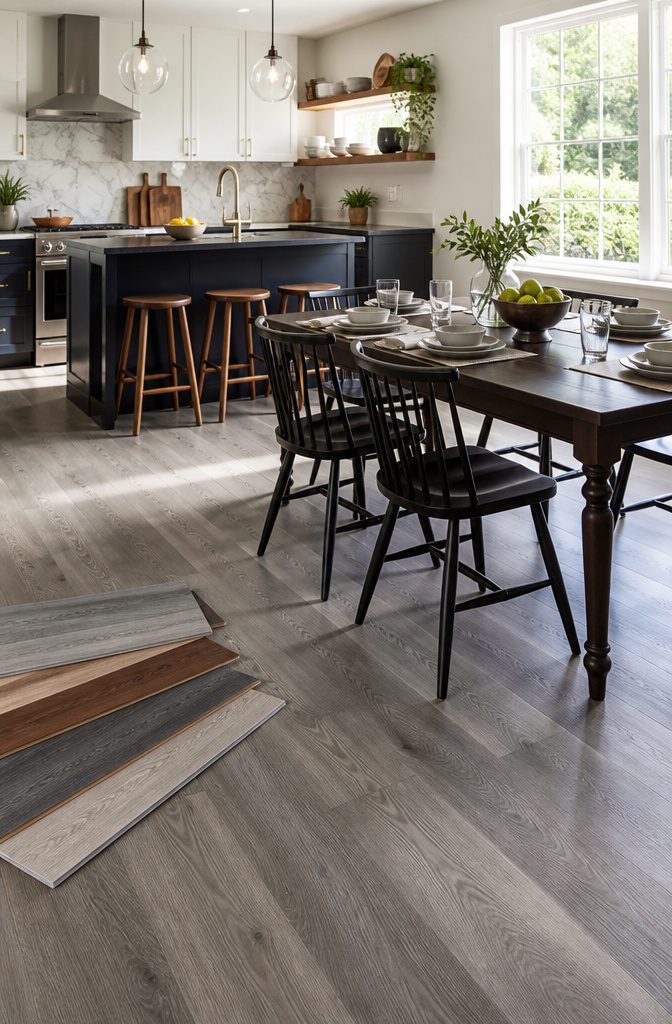
A wear layer of 2 mm or more ensures durability for decades of use.
Wear Layer Thickness
The wear layer is the slice of real hardwood sitting on top of the plywood or fiberboard core, and its thickness decides whether you are buying a floor you can live with or a floor you can live with for decades.
A thicker layer, 2 mm and up, means the boards can take a sanding and refinishing when scratches accumulate or when you want to shift from a honey tone to something cooler.
Thinner layers, common at the budget end of the market, lock you into the original finish; once it wears through, replacement is the only move.
This matters most if you are buying for a long-term home, have kids or dogs, or simply know yourself well enough to admit you will want a different look in eight years.
Renters and anyone planning to sell within three to five years can safely treat wear layer thickness as a secondary concern. The floor will likely outlast your stay regardless.
Moisture Resistance
Engineered hardwood handles moisture better than solid plank because the cross-layered core resists the expansion and contraction that warps solid wood. That said, "better" does not mean "waterproof."
Kitchens, basements, and bathrooms with occasional splashes or humidity swings are where this category earns its keep. Some cores use more stable materials, and some finishes repel water longer, but every product line has a saturation point.
Buyers in the Gulf South, the Pacific Northwest, or any house with a history of basement seepage should weigh this heavily. The same goes for anyone running planks through a kitchen where the dishwasher will eventually leak.
If you are installing on a dry above-grade floor in Arizona, moisture resistance drops down the priority list. The recurring damage owners report, cupping and delamination, almost always traces back to water the floor was never built to take.
Installation Method
Glue-down, nail-down, and floating each create a different relationship between you, the floor, and the subfloor beneath it. Nail-down demands a plywood subfloor you can drive fasteners into and the tools or budget to do it right.
Glue-down works over concrete but requires evenness and patience; uneven slabs telegraph through, and rushed adhesive work leads to hollow spots that squeak or separate.
Floating clicks together over underlayment and goes down fastest, though the hollow sound underfoot bothers some owners and the locked joints can fail if the subfloor is too uneven.
DIYers with a weekend and a rental inspection looming should look hard at floating systems. Anyone with wavy concrete or a timeline measured in hours, not days, should be realistic about whether glue-down is a project they want to own.
The installation difficulties buyers report, boards that gap or pop, usually come from method and subfloor mismatch rather than the planks themselves.
Cost per Square Foot
This category spans a wide range, from budget options that get you the look of wood on a tight outlay to premium lines that approach solid hardwood pricing.
The spread matters because the visible floor is only part of the total. Underlayment, adhesive, trim, and the tools or labor to install it all pull from the same pool.
First-home owners stretching to cover a whole house should care most here, and they should calculate total project cost, not just plank price per square foot.
A mid-range floating floor with free underlayment included can end up cheaper than a bargain glue-down once materials and rental tools stack up.
Buyers covering a single room or working with an installer who charges flat rates can afford to weight cost less heavily. Know your full number before you fall for a plank sample.
Brand Reputation and Design Variety
These two factors sit together because they are both about narrowing a field that is otherwise overwhelming.
Brand reputation, built from owner reports about customer service, consistency between batches, and how claims hold up over years, separates the reliable from the gamble.
Design variety, the range of species, plank widths, and surface textures, determines whether you will find something that belongs in your particular room.
Buyers who have been burned by a previous flooring project, or who read the forums where moisture failures and premature wear get documented, should prioritize reputation.
Buyers with a specific vision, wide-plank white oak with a wire-brushed finish, for example, need to find a line that actually stocks it before they worry about who made it.
If you are flexible on look and willing to order samples from three sources to compare, design variety matters less. If you need a floor that will still be replaceable under warranty in fifteen years, reputation matters more.
Warranty Terms and Sustainability Certifications
Warranty length and coverage are often treated as a proxy for quality, though the fine print matters more than the headline number.
Some warranties cover wear through the finish only, others cover structural integrity, and almost all have installation requirements that void coverage if ignored.
A thirty-year residential warranty sounds generous until you learn it demands professional installation and specific humidity controls your house cannot maintain.
Sustainability certifications, FSC chain of custody, CARB Phase 2 compliance, and similar, appeal to buyers who track the origin of materials. These add confidence about off-gassing and forestry practices, though they rarely change how the floor performs underfoot.
Both factors are tiebreakers. If you have narrowed to two products that match on wear layer, moisture handling, and price, the longer, more transferable warranty and the certified sustainable core can decide it.
For a basement laundry room or a rental you will not own in two years, either one can be safely set aside.
How the Top Picks Compare
Mirage’s 0.16 inch wear layer is double that of Mohawk and Malibu Wide Plank.
The wear layer thickness splits these five into two camps, and the gap between them matters more than the numbers themselves.
Mirage sits at 0.16 inch, double what Mohawk and Malibu Wide Plank offer.
In a busy hallway with a dog and a rolling desk chair, that extra depth means the first sanding job comes years later, and you might get two or three sandings total instead of one.
For someone who bought a fixer-upper intending to stay put, that longevity is worth planning around.
The tradeoff shows up in the upfront cost; Mirage runs premium, and if you are renting or suspect you will move in five years, you are paying for sandings you will never schedule.
Somerset splits the difference at 0.12 inch with a 50-year warranty backing it. That warranty length signals confidence in the core construction, not just the veneer, and it outlasts Mohawk’s 25 years by a full generation.
For a first-home owner who panics at the word "refinish," the paperwork matters; for a serial renovator who trusts their own maintenance, the extra decades on paper may never get tested.
Mohawk and Malibu Wide Plank both hit 0.08 inch, but Mohawk’s 25-year warranty against Malibu’s 20 suggests tighter quality control on the core or the locking system, not the surface you see.
The five-year gap matters if you are laying this in a rental and want the warranty to transfer, or if you simply sleep better knowing the coverage runs longer.
The Malibu line wins on upfront budget, and for a guest bedroom or a home office that sees dress shoes, not boots, the thinner wear layer will likely outlast your taste in stain color anyway.
Mannington’s moisture resistance sits apart from the thickness conversation entirely. In a basement or over a concrete slab that breathes, the engineering of the core matters more than how many sandings the top will take.
No wear layer saves a floor from a subfloor that wicks water; Mannington’s value is in buying you time when the humidity spikes, not in surviving decades of grit.
The real choice is not which number is biggest. It is whether you are buying years of surface life, years of structural coverage, or forgiveness against the water you cannot control.
Maintenance and Care
The wear layer is what separates a floor you can live with from one you babysit. At 2 mm, you get a surface that handles regular cleaning and the occasional dropped spoon, but refinishing is basically off the table.
Bump to 3 mm and you gain some sanding room down the line. At 4 mm, you are buying the option to refinish once or twice over decades, which matters if you are in a house you plan to stay in.
For daily care, the routine is boring and that is exactly why it works. A soft-bristle broom or microfiber mop, dry or barely damp.
I have read enough owner reports to know that wet mopping is where people get into trouble, especially in kitchens and basements where the moisture resistance gets tested in real life. Standing water finds seams.
Entryway mats cut down the grit that causes scratches. Felt pads under chairs.
These are small habits that cost almost nothing and show up in the warranty claims that go smoothly versus the ones that get denied.
Some of the 50-year wear warranties require proof of basic maintenance; the 20-year terms tend to be more forgiving but also run out faster.
Humidity swings are the hidden factor. Solid hardwood expands and contracts dramatically, which is why engineered exists.
Still, owners in climates with real seasons describe gaps opening in dry winters and tight seams in humid summers. A cheap hygrometer and a basic humidifier routine do more than premium finish ever will.
If you are floating the floor, the install method itself becomes part of maintenance. Glue-down and nail-down stay put; floating shifts slightly with traffic and climate.
That is not failure, but it means your expansion gap at the walls has to stay clear of heavy furniture and built-ins.
I have seen this come up in DIY writeups where someone anchored a bookshelf through the floor and pinned the whole assembly.
Installation Tips
Most engineered hardwood goes down as a floating floor with click-lock edges, and that is where weekend projects live or die.
The boards need to expand and contract as a single sheet, so every wall gets a gap, usually 3/8 to 1/2 inch, hidden later by baseboard.
I have seen enough owner reports to know that skimping on this gap is the fastest way to end up with peaked seams or a floor that sounds like popcorn when you walk across it.
The subfloor matters more than the boards in some ways. It has to be flat within 3/16 inch over 10 feet; high spots telegraph through, low spots make the locks strain and eventually fail.
A long level and a bag of self-leveling compound fix most sins, but the compound needs its full cure time, not the impatient version where you start laying at dawn the next day.
Moisture is the other killer. A 4 mm wear layer gives you refinishing room later, but only if the boards never cup from humidity swings.
A moisture meter reading on both the subfloor and the delivered boards, acclimated for 72 hours in the room, catches problems before they are trapped under a thousand square feet of flooring.
Basements and kitchens need this step most; even products rated for moisture-prone areas fail when installed into wet concrete or against a leaking dishwasher line.
Glue-down and nail-down methods remove the floating-floor movement issue but demand their own precision.
Glue requires the right trowel notch and working time; nail-down needs a flooring stapler set to the correct depth, not a finish nailer grabbed from the trim pile.
The wrong tool leaves raised nails, split tongues, or a floor that loosens over months of foot traffic.
For DIY installs, the click-lock floating method wins on forgiveness. A bad board lifts out.
A bad glue seam is permanent. Floating floors carry a hollow sound without quality underlayment, and heavy furniture or a piano needs felt pads and maybe a load-spreading mat to protect those interlocking edges.
Engineered wood flooring offers the look and feel of hardwood with one significant advantage: The substrate makes each plank less susceptible to seasonal shrinking and swelling than solid wood. That additional stability minimizes gaps between boards that can appear in dry conditions.
Cost Comparison
The wear layer is where most of the money goes, and it is the first place to look when you are deciding what tier you are actually shopping in.
A 2 mm veneer gets you a floor that looks like hardwood and acts like hardwood for a while, but refinishing is basically off the table.
Owners with dogs, kids, or a habit of rearranging furniture every spring report that the surface shows wear faster than they expected.
The 20-year warranty on some of these lines lines up with that reality; you are buying a floor with a known lifespan.
Step up to 3 mm and the conversation changes.
You gain the option to sand and refinish once, maybe twice if you are careful, and the moisture resistance moves from "better than solid hardwood" to something you can actually install below grade without holding your breath.
The 50-year wear warranties at this level signal what manufacturers think the core and the veneer can take together.
At 4 mm you are in premium territory. The floor can be refinished multiple times, which matters less for the first ten years and more for year fifteen when the kitchen still looks tired but the cabinets are fine.
Multiple installation methods, full waterproofing, and lifetime residential warranties come standard here. The real question is not just the upfront cost; it is the commitment to a floor you will live with long enough to justify it.
For a weekend project on a tight budget, 2 mm gets the job done. For a house you are settling into, 3 mm is the practical middle.
The 4 mm lines reward the owner who can wait out the cost over decades, not months.
Frequently Asked Questions
What wear layer thickness should I look for in engineered hardwood?
A 4 mm wear layer gives you the most refinishing options and the longest lifespan, while 2 mm limits how many times the floor can be sanded and may keep the total lifespan under 20 years.
I have seen 3 mm layers positioned as a middle ground, though that figure appears less often in the spec sheets I compared.
If you plan to stay in the home long enough to refinish once or twice, the thicker layer pays for itself.
How does engineered hardwood handle moisture compared to solid hardwood?
Engineered hardwood is more resistant to moisture than solid hardwood, and some lines are labeled fully waterproof rather than just resistant. Buyers report this matters most in kitchens, basements, and any room where humidity swings with the season.
Mirage in particular turns up in owner discussions for moisture-prone areas, though I would still run a hygrometer for a week before installing in a below-grade space.
What installation methods work for engineered hardwood?
Glue-down, nail-down, and floating are all common options, and most brands offer at least two of the three.
Floating installation appeals to renters or anyone who might want to take the floor with them; glue-down suits concrete subfloors common in basements and newer construction.
The method you choose affects both the tools you need and whether you can handle the job over a weekend.
What warranties come with engineered hardwood floors?
I found warranties ranging from 20 years to lifetime residential coverage, with 25 years and 50 years appearing in between depending on the brand line. The length usually tracks with wear layer thickness, not surprisingly.
A 20-year warranty on a 2 mm product is typical; 50 years or lifetime coverage tends to pair with 3 mm or 4 mm layers. Read what actually triggers a claim, since moisture damage from installation error often voids coverage.
How do I budget for engineered hardwood without knowing exact prices?
The research sorts cleanly into three tiers. Premium products with thick wear layers, wide design variety, and strong sustainability certifications sit at the top.
Mid-range options usually trade some refinishing lifespan for lower upfront cost. Value lines with 2 mm wear layers and shorter warranties keep the entry point manageable, though owner reports of limited lifespan under 20 years are worth weighing against the savings.
Delivery support from big-box retailers can reduce hidden costs for the value tier, while premium lines rarely need that backup.