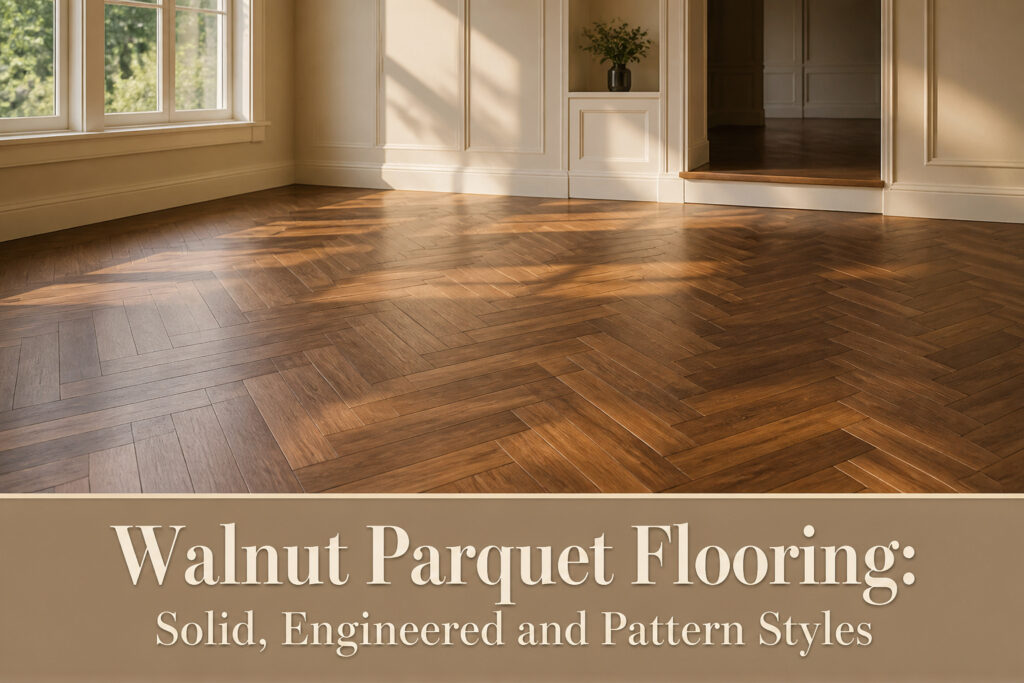
Walnut parquet flooring is a patterned wood floor built from short walnut pieces arranged in geometric designs like herringbone or chevron.
Installation is where herringbone gets expensive: those angled cuts leave waste and demand a subfloor flat to within an eighth of an inch, which adds a full day of prep before a single piece goes down.
At a Janka hardness of 1010, walnut dents more easily than oak, though its darker color swallows minor damage into a patina over time.
[link-whisper-related-posts]Solid Walnut Flooring
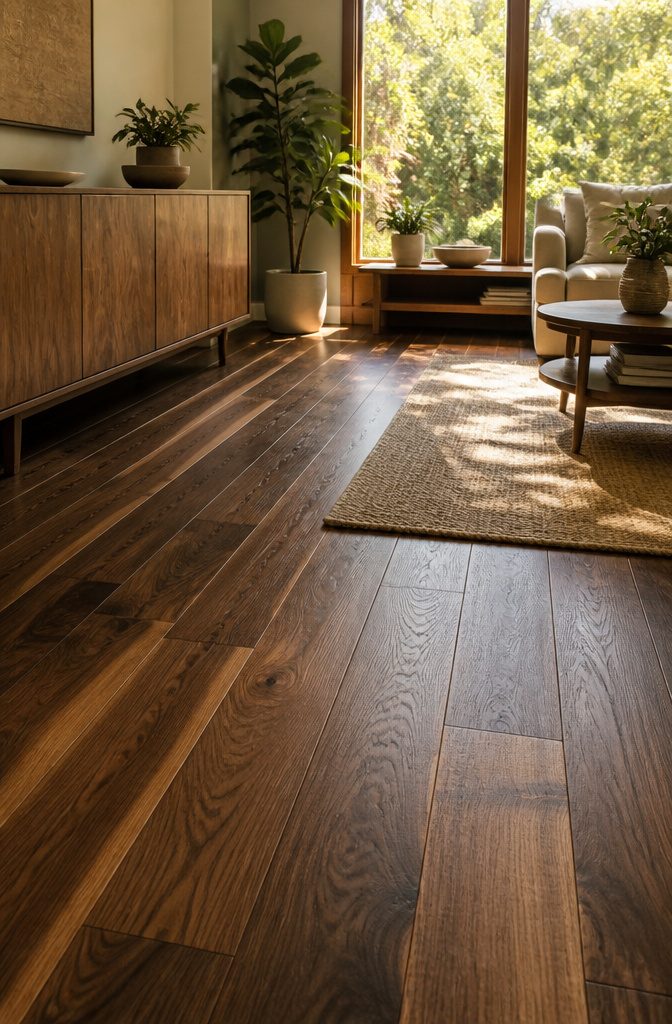
Solid walnut flooring starts with a single piece of wood milled to full thickness, usually 3/4 inch, which is why it can be sanded down and refinished four or five times over a lifetime.
That thickness buys you longevity, but it also limits where the floor can go. Basements and any below-grade space are out; the moisture risk is too high, and the boards will cup or warp.
The 1010 Janka hardness rating puts walnut on the softer side of domestic hardwoods. A dropped cast-iron pan or a stiletto heel will leave a dent you can feel under sock feet.
In my own house, I learned to keep felt pads under anything that moves and to own the dents rather than fight them. The wood darkens and develops a patina that eventually swallows minor abuse into the character.
Widths run up to 12 inches on some mills, though wider boards cost more and show more seasonal movement.
Solid walnut expands and contracts with humidity shifts across the year, so it needs an expansion gap at every wall and a stable interior environment.
If your climate swings hard between seasons or you keep the heat blasting dry air in winter, engineered construction handles that stress better.
Engineered Walnut Flooring
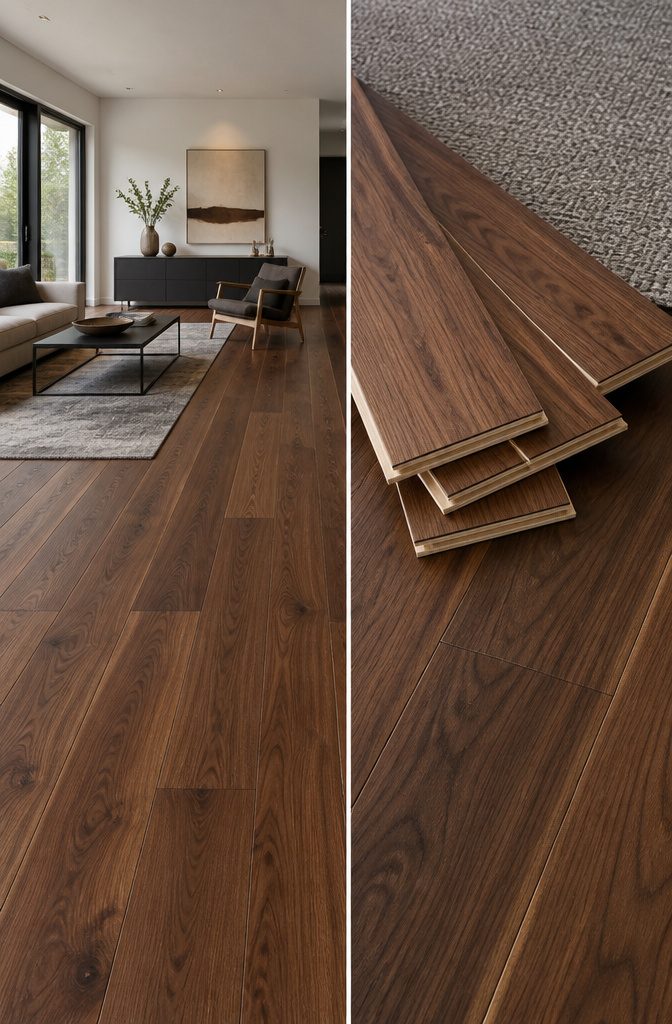
Engineered walnut flooring swaps a solid plank for a sandwich: a thin walnut veneer glued over a plywood or fiberboard core.
That core is what keeps the floor flat when humidity swings, which matters in basements or any room below grade where solid walnut would cup or gap.
I learned the hard way that installation method changes with the subfloor. Concrete slabs usually mean glue-down.
Plywood subfloors over joists take nail-down. A floating click-lock install works over an existing floor or radiant heat, though the click profile limits how wide your planks run.
Vermont Plank mills engineered walnut up to 12 inches wide; solid goes the same, but the engineered version is the one you want on concrete.
Refinishing is where engineered walnut gets tricky. Sanding engineered walnut eats straight through the veneer into the core beneath.
Thicker veneer, more sandings possible. A 2-mm wear layer might survive one light refinish; 4 mm gives you two or three.
Ask before you buy, because once that veneer is gone, the floor is done.
Prefinished Walnut Flooring
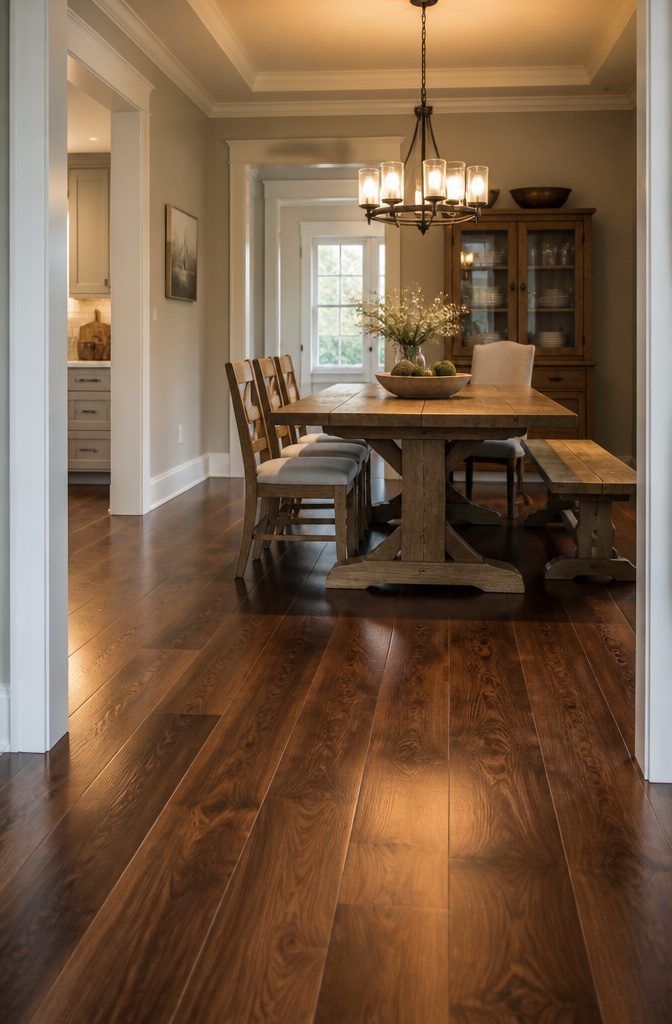
Factory-applied UV-cured coatings on prefinished walnut parquet flooring let you walk on the surface the same day it goes down.
That speed matters when you’re turning a spare room over a long weekend and sleeping three doors down from the dust.
The finish layer comes out even, which site-finished floors often don’t. A contractor brushing polyurethane in your living room is working around corners, light, and the clock; a factory booth controls all three.
That consistency shows up under a dining table where the wear concentrates, or at a window where sun hits hardest.
Aluminum oxide or ceramic coatings baked in under UV light add real hardness without the amber tone oil-based poly gains over time. I’ve seen prefinished floors take years of chair scraping before the wood itself starts to give.
The tradeoff comes later. A deep scratch or water ring that breaks through the coating needs a repair that matches a factory finish you can’t replicate in a basement.
Site-finished floors sand clean and start over; prefinished ones demand spot treatments that never quite disappear into the surrounding gloss. For a renter or a first-time owner without a floor sander, that durability usually wins.
For someone planning to stay fifteen years and refinish once, the math shifts.
Unfinished Walnut Flooring
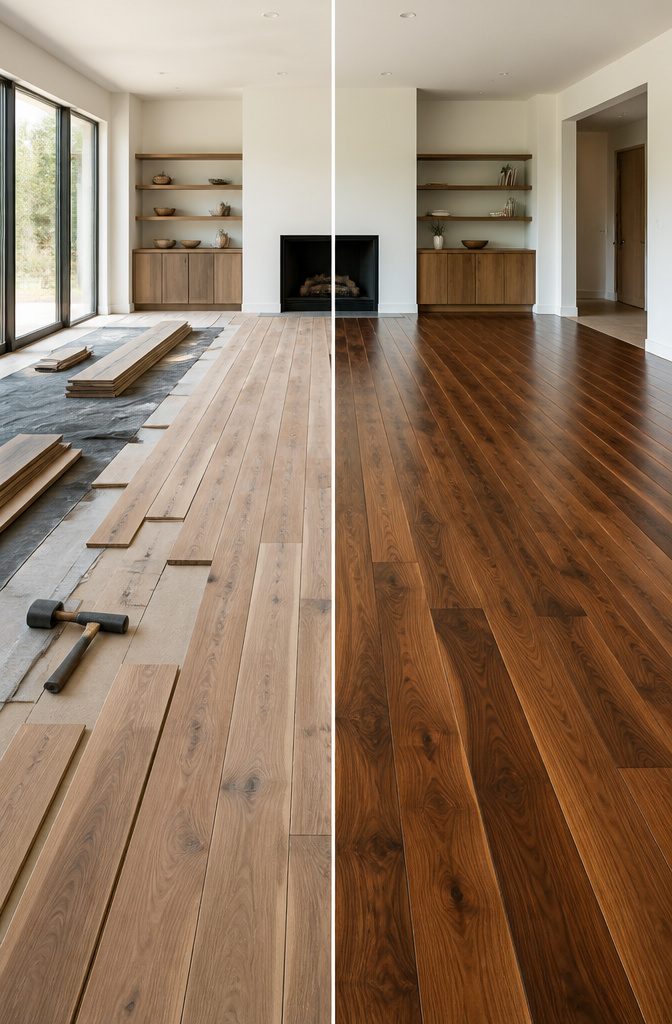
Raw walnut planks that arrive unfinished and get sanded and sealed after installation run $14 to $32 per square foot, a spread that reflects grade, width, and whether the plank is solid or engineered.
What you gain is control: you pick the stain color, dial in the sheen from matte to satin to gloss, and the installer can feather boards together at the seams so the floor reads as one continuous surface rather than a grid of prefinished panels with micro-bevels catching dust.
You pay for that control with time and mess. Sanding on site throws fine walnut dust into every corner of the house, and the finish needs multiple coats with drying intervals between them.
Owners on Reddit mention losing use of the space for several days while the oil-based sealers cure, and even water-based systems leave the room off-limits overnight between passes.
For a weekend-project budget, that downtime can strand the kitchen or the only bathroom at the wrong moment.
Wide Plank Walnut Flooring
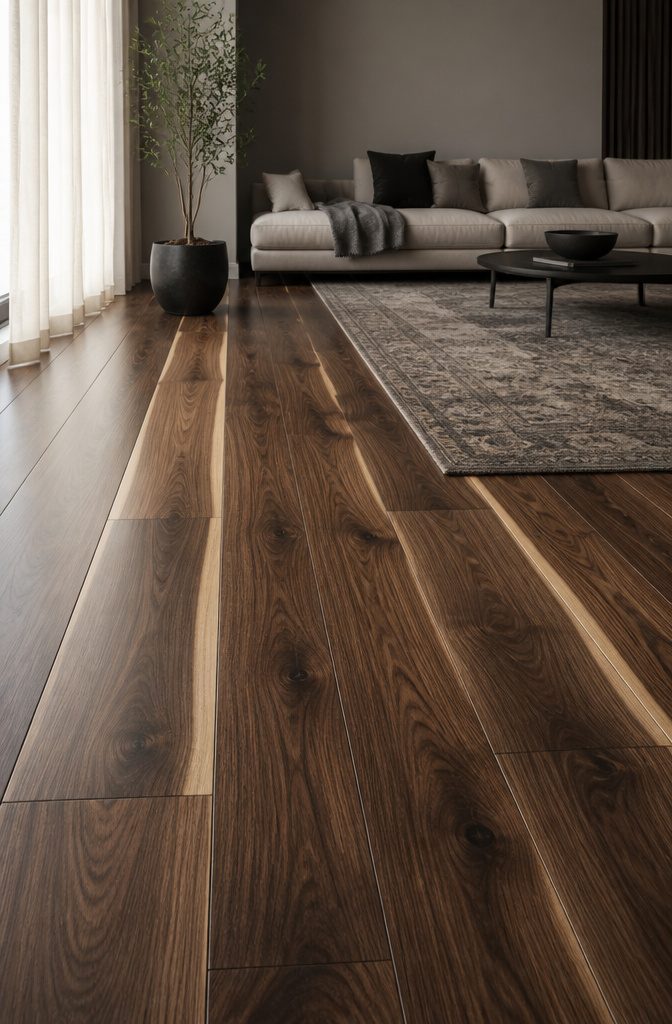
Planks milled from 4 inches up to 12 inches and wider carry more of walnut’s natural drama across each board, with fewer seams breaking up the grain.
That breadth matters for this species because the contrast between creamy white sapwood and the dark brown to purplish-black heartwood is already pronounced; spread across a wide surface, the variation reads as intentional character rather than a mismatched batch.
I would not install these in a basement or anywhere humidity swings hard without planning for it. Wider boards move more seasonally than narrow strip flooring, and walnut at 1010 lbs on the Janka scale is moderate in hardness, not rigid.
Some installers prefer adhesive with a vapor barrier or a floating method over nailing, depending on the subfloor and the local climate.
The matte finishes that help hide scratches on walnut also suit the relaxed scale of a wide plank, where high-gloss sheen can turn every tonal shift into a spotlight.
For renters or first-home owners, the practical limit is usually the room itself: wide planks need space to read as proportionate, and a 12-inch board in a 10-foot-wide galley kitchen can feel like a plank thrown down a hallway.
Character Grade Walnut
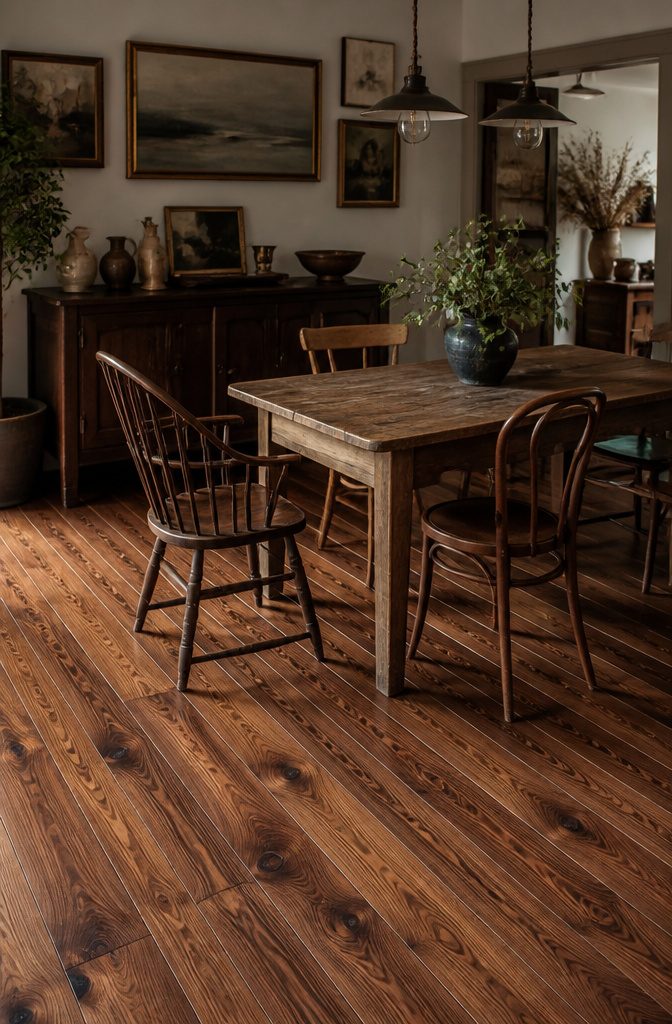
Character grade walnut keeps what the mills usually throw away. Knots, mineral streaks, and the full range of color variation stay in the boards: yellow-brown, pinkish-brown, sometimes greyish tones that show up in less selective cuts.
Where select grade demands uniformity, this grade lets walnut look like walnut.
The price gap matters for anyone covering a kitchen or a whole living room on a real budget. Character grade runs cheaper than select, sometimes by a noticeable margin, and that difference buys more square footage or a better underlayment.
These boards suit spaces that already have some age on them. A 1920s bungalow, a farmhouse dining room, anywhere the floor is supposed to look like it was laid decades ago rather than yesterday.
The streaks and knots read as history, not flaw, and in a herringbone or chevron pattern the variation actually helps the geometry feel less mechanical.
In a brand-new build with white walls and stainless everything, the same floor can look busy; the context decides whether the character works or fights the room.
Select Grade Walnut
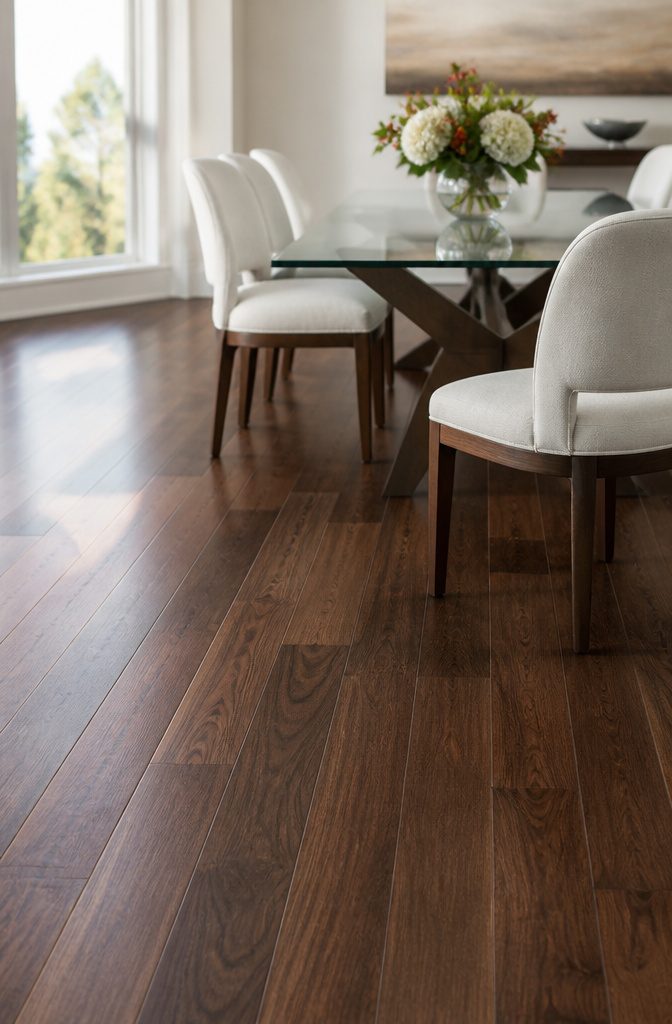
Select grade walnut runs almost entirely from heartwood, so the color stays in that deep brown range without the lighter streaks sapwood brings.
Knots are minimal to none, and the grain stays uniform enough that a herringbone or chevron pattern reads as geometry first, wood second.
The scarcity of clear walnut boards pushes the price well above oak, and engineered options only narrow that gap so much.
In a formal dining room or a contemporary space with clean lines, the premium starts to make sense; the floor does the visual work without competing against furniture.
Lighter upholstery or pale oak tables against that dark, even field create the contrast that makes both elements stand out.
I would not spend the upcharge in a room already loaded with visual noise.
Busy wallpaper, layered rugs, and select grade fight each other for attention the same way a loud print and a statement necklace do on the same outfit.
Choose this grade when the floor needs to carry the room’s elegance on its own.
Walnut Parquet Patterns
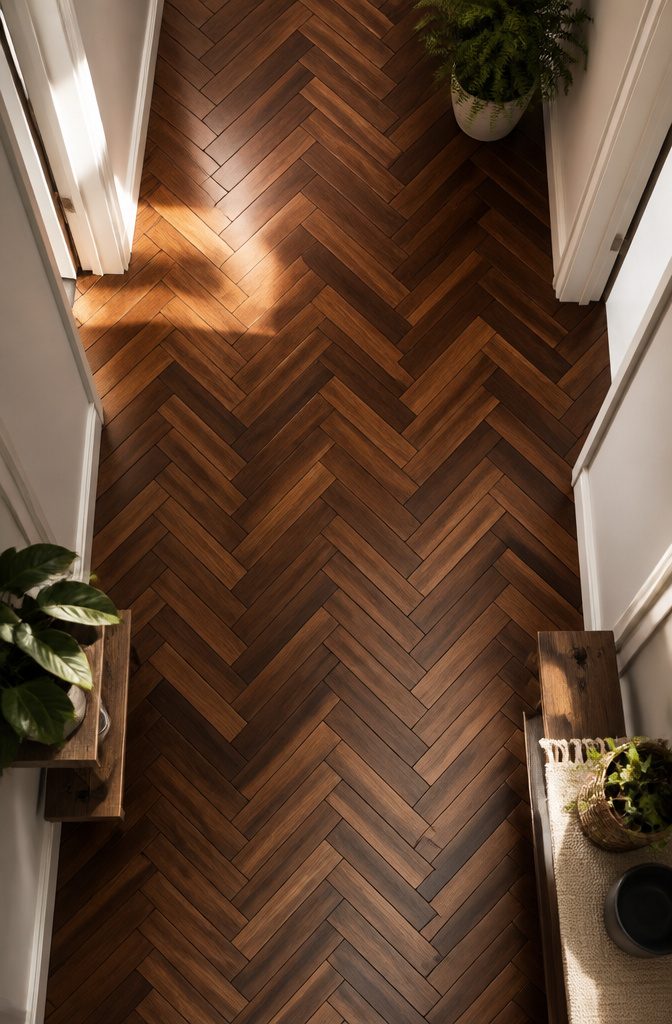
Herringbone walnut parquet arranges short boards in a staggered zigzag that catches light differently across the day, while chevron cuts each end at an angle so the planks meet in sharp points instead of broken steps.
Both patterns came about centuries ago as a way to use up offcuts and short lengths that full plank floors would have discarded, turning scrap into something that makes a room feel like it is moving under your feet.
The geometry demands more from the subfloor than plain boards ever will. A ridge or dip of even an eighth inch telegraphs through the pattern as a visible flaw, so self-leveling compound and serious sanding are usually mandatory first steps.
That prep adds a full day before the first piece goes down.
Waste runs higher too. All those angled cuts leave triangles behind, and a box calculated for straight installation will not stretch to a herringbone layout.
Labor follows the same math: the installer is setting individual pieces, not running long rows, and the pattern at least doubles the time on the floor.
For a weekend project with a rental deadline, that difference can push parquet from ambitious to undoable.
What Walnut Costs and Why
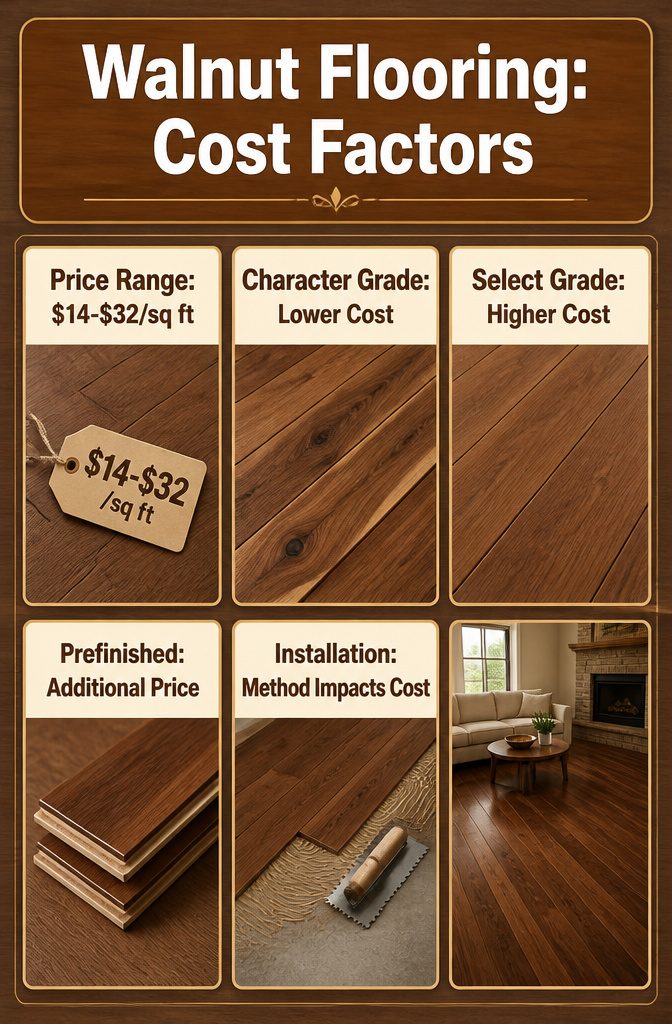
Walnut parquet flooring runs steeper than oak for a reason: the tree grows slower and there is simply less of it. That scarcity carries straight to the price tag.
Unfinished walnut starts at $14–$32 per square foot before grade, finish, or installation method enter the picture.
Grade matters more than I expected. Character grade with its knots and color variation costs less than Select, which keeps to straighter grain and more uniform tone.
Width pushes the number too; a 12-inch solid plank commands more than a 4-inch strip, and engineered options usually land below solid for the same visual footprint.
Prefinished adds convenience but tacks on cost, while engineered construction narrows the gap toward oak territory without giving up the walnut face.
Installation method sealed my own budget. Floating an engineered floor over concrete ran cheaper than glue-down or nail-down, but site-finished solid planks meant hiring out sanding and sealing, which moved the total well past that $32 mark.
For a weekend project with real constraints, engineered prefinished in Select grade hit the balance: walnut look, manageable install, price that did not require a second mortgage.
Durability and Daily Wear
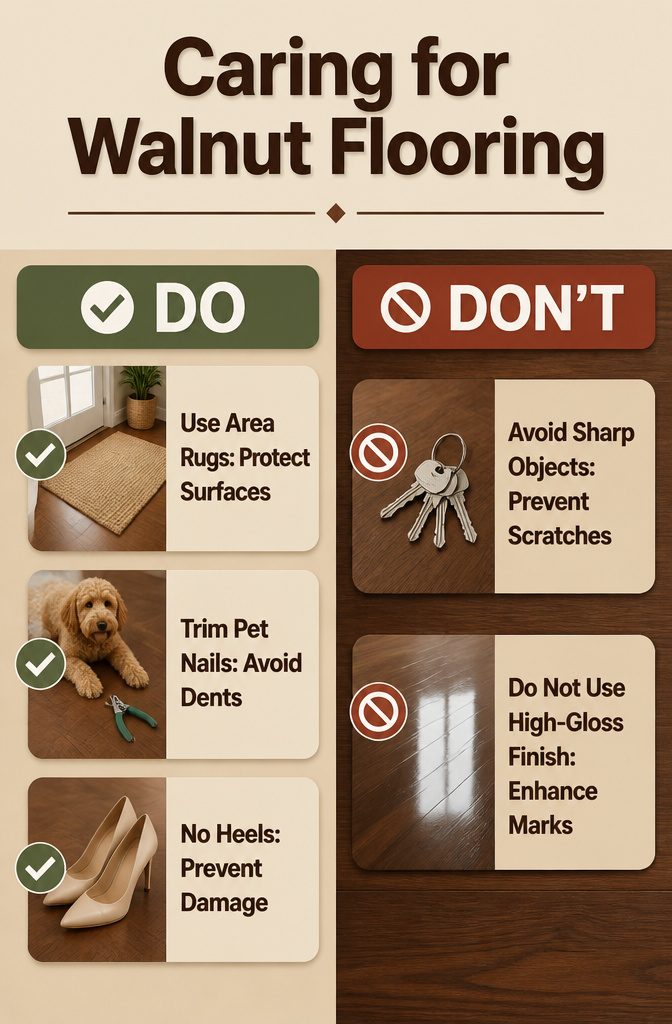
A 1010 Janka hardness rating puts walnut on the softer side of domestic hardwoods. That number means a stiletto heel or a dropped cast-iron pan will leave a dent you can feel with your fingertip, not just a surface scuff.
I learned to treat my own walnut floors with the same caution I’d give a pine table: area rugs at the front door and under the desk chair, pet nails kept trimmed, and a strict no-heel policy that my partner still forgets once a month.
Walnut’s darker pigmentation helps conceal minor dents and scratches better than lighter species, and the wood can be sanded and refinished to restore its original richness.
What that means in practice: the dents will still happen, but you may stop noticing them before they actually accumulate enough to require a full refinish.
Over years, walnut develops a patina, a softening of color and sheen that some owners prize as character and others call damage when they first spot it.
The matte finishes that are popular now make marks less obvious than high-gloss would, so if you’re already eyeing a satin or flat sheen, you’re working with the wood instead of against it.
Color and Room Size
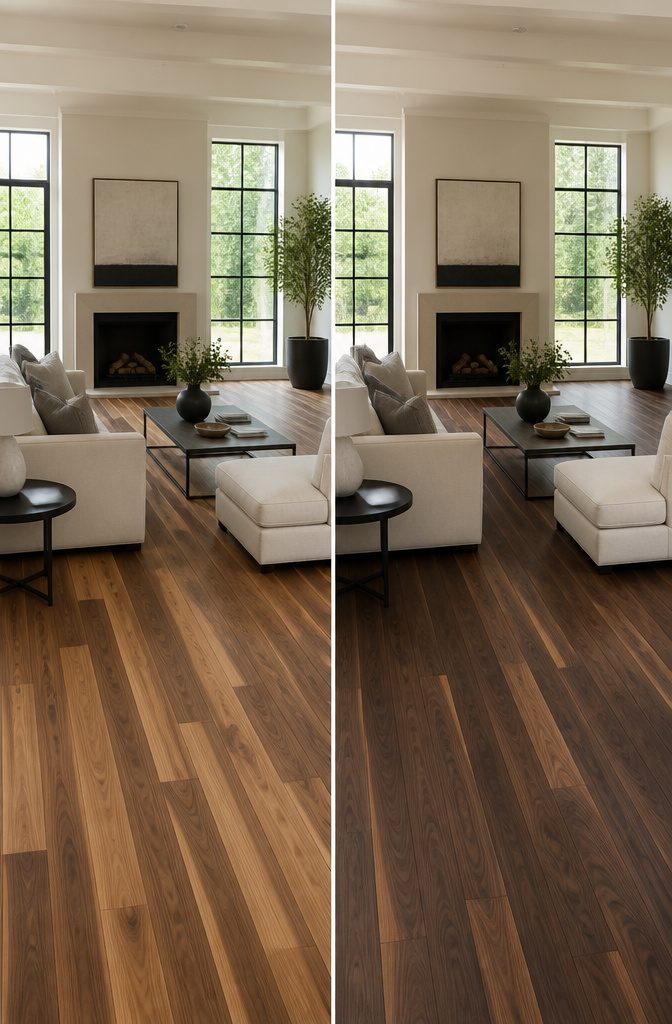
Walnut can feel too dark for a small room, but the grade you choose matters as much as the square footage.
American walnut heartwood runs from rich dark brown to purplish black, while the sapwood stays creamy white or tan. The PR/RU grades keep more of that lighter sapwood along the edges, which softens the overall field.
RU/CA grades push deeper into the heartwood, so the same herringbone pattern reads as almost chocolate in low light. I would not put RU/CA in a room under 12 feet across without planning around it.
The yellow-brown and pinkish-brown tones that show up in steamed walnut, sometimes veined with grey, give you more play than the heartwood alone suggests.
Those mid-tone boards reflect more light than the deep purple-black pieces, and they age lighter over time rather than darker like oak tends to.
If the room is small and the floor is already down, the fix is in what surrounds it.
Walls in a clean neutral, furniture with real contrast in tone, and enough actual wattage overhead keep the floor from swallowing the space.
A matte finish helps too; gloss catches every shadow and makes the darkness feel deeper than it is.
Installation Methods by Floor Type
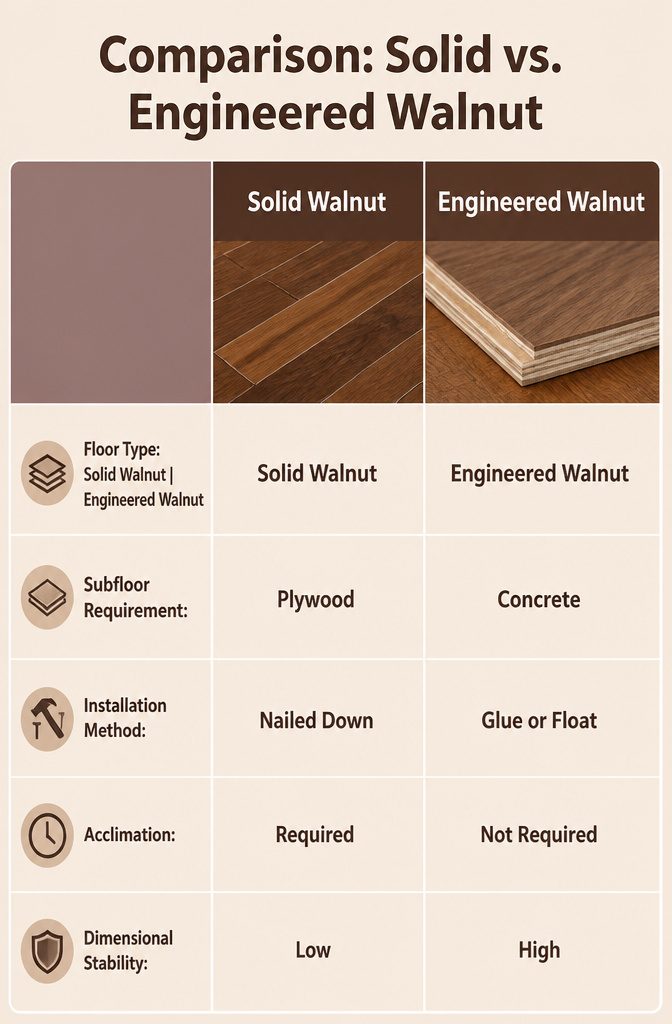
Solid walnut parquet needs a plywood subfloor and gets nailed down; the strips have to acclimate to the room’s humidity for several days before that happens, or the tongues fight you every row.
Engineered walnut is where the options split open.
The same engineered construction that handles below-grade family rooms and basements lets you glue it directly to concrete, provided the slab has a moisture barrier, or float it as a click-lock system that goes over an underlayment.
Floating engineered over concrete with a vapor barrier beats glue-down for the weekend timeline, since you’re not waiting for adhesive to cure before you walk on it.
Engineered’s layered build resists the dimensional shifting that warps solid walnut in damp conditions, which is why solid is a nonstarter for basements no matter how good the vapor barrier looks on paper.
Frequently Asked Questions
Is walnut wood good for flooring?
Yes. Walnut offers rich chocolate-brown color and distinctive grain patterns that work in both traditional and modern interiors.
The 1010 Janka hardness rating suits most residential spaces, and the wood develops a patina over time that many owners prize. Its darker pigmentation also helps conceal minor dents and scratches better than lighter species.
How much does walnut hardwood flooring cost?
Unfinished walnut flooring runs $14 to $32 per square foot before installation, with the final total climbing past that range once you factor in grade, width, finish, and labor.
Character grade costs less than Select, while engineered construction usually lands below solid for the same visual footprint.
Prefinished adds convenience but tacks on cost, and site-finished solid planks with professional sanding and sealing push the total well above the baseline.
Is walnut flooring too dark?
It can feel too dark in small rooms, but the grade you choose matters as much as the square footage.
PR/RU grades keep more of the lighter creamy sapwood along the edges, which softens the overall field, while RU/CA grades push deeper into the heartwood for a nearly chocolate tone.
Pairing walnut with neutral walls, lighter furnishings, and enough overhead lighting keeps the floor from swallowing the space, and a matte finish avoids the shadow-catching depth that gloss creates.
What size planks are available?
Walnut can be milled in widths from 4 inches up to 12 inches and wider, though wider boards cost more and show more seasonal movement.
Both solid and engineered constructions reach the 12-inch maximum at some mills, but engineered click-lock profiles may limit width depending on the system.
A 12-inch plank in a 10-foot-wide room can feel out of proportion, so the space itself often sets the practical limit.
What are the disadvantages of walnut flooring?
The 1010 Janka hardness rating puts walnut on the softer side of domestic hardwoods, so dropped cast-iron pans and stiletto heels will leave dents you can feel.
Solid walnut cannot go in basements or below-grade spaces because moisture will cup or warp the boards. The wood also expands and contracts with humidity shifts, requiring stable interior conditions and expansion gaps at every wall.
What is the disadvantage of parquet flooring?
Parquet patterns demand more subfloor preparation than plain boards; even an eighth-inch ridge or dip telegraphs through as a visible flaw, so self-leveling compound and serious sanding are usually mandatory first steps.
Waste runs higher because angled cuts leave triangles behind, and a box calculated for straight installation will not stretch to a herringbone layout.
Labor at least doubles compared to running long rows, which can push parquet from ambitious to undoable for a weekend project with a deadline.
Is a parquet floor expensive?
Parquet costs more than straight plank installation because of the extra labor and waste. The pattern at least doubles the installer’s time on the floor, and the angled cuts of herringbone or chevron leave unusable triangles behind.
Walnut parquet specifically runs steeper than oak parquet because the tree grows slower and there is simply less of it, carrying that scarcity straight to the price tag.