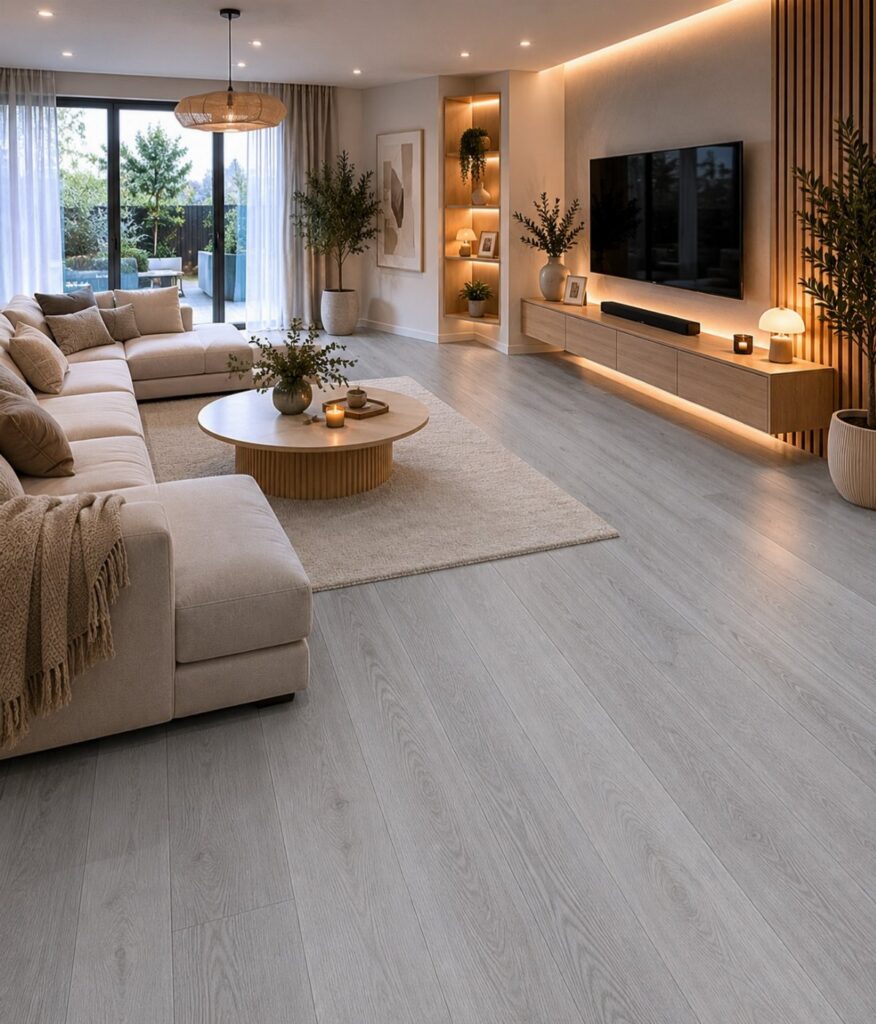
Cool tone wood floors run from budget laminate you can lay on a staircase yourself to wide engineered planks, and the deciding factor is whether you own the subfloor or answer to a landlord.
The undertone is what matters, not the species name on the sample tag, and it shifts against your actual wall color from morning through evening.
[link-whisper-related-posts]1. Gray Tones
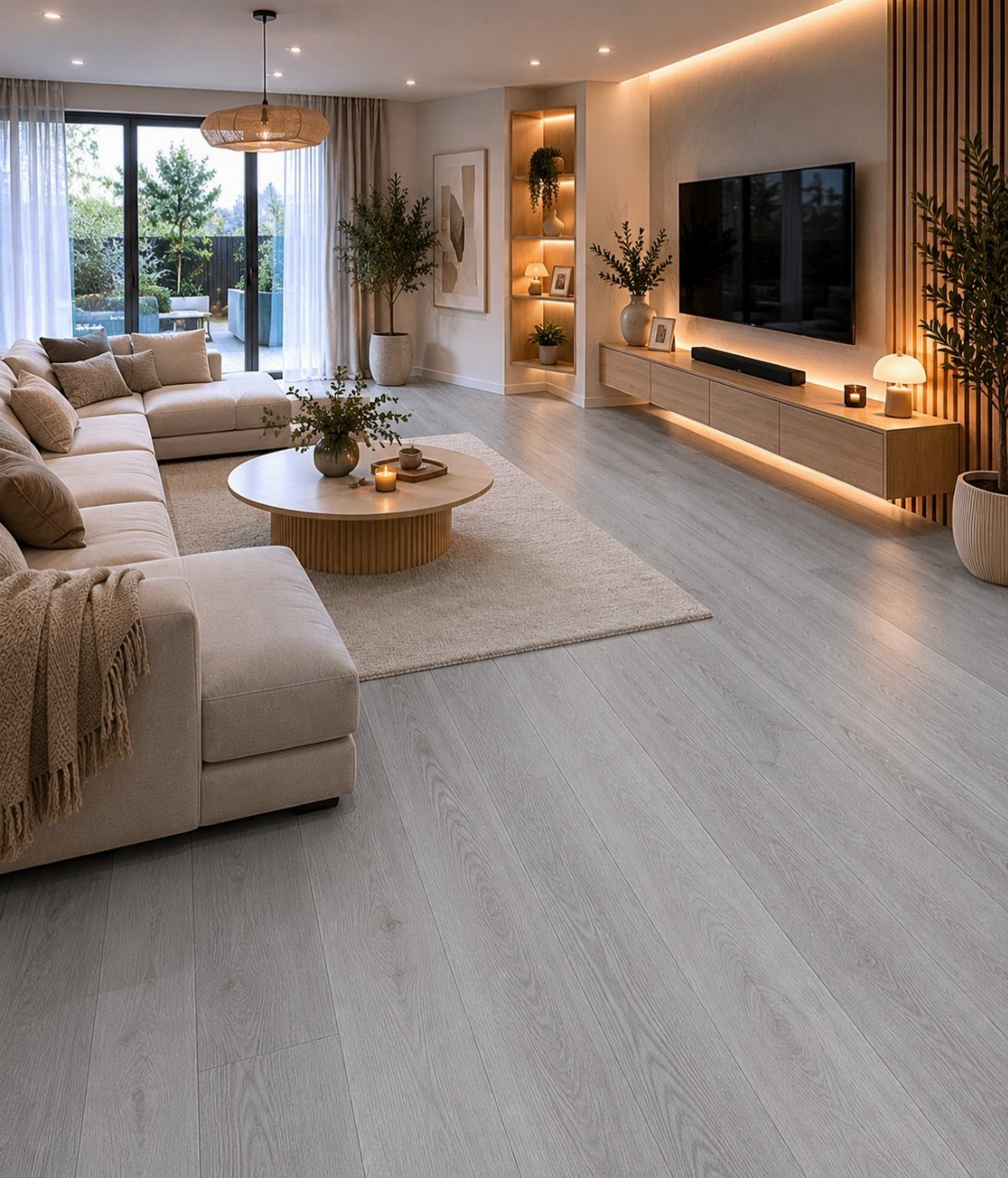
Gray tones hit a middle ground that reads modern without going cold.
Gray-tone floors pull together rooms where the furniture already leans warm, like a beige sectional or wood table, because the floor stays quiet enough to let those pieces talk.
The specific products that land here include Mullican Wexford in Marble or Harbor Mist, Shaw Paladin Plus Fresh Pine, and Anderson Tuftex Kensington Pembridge. Most run 3/4 inch or 5/8 inch thick, with widths from 4 inches up to 8 inches.
This is the choice for anyone who wants flexibility: the neutral base handles a decor swap in 3 years without clashing.
2. Natural Oak
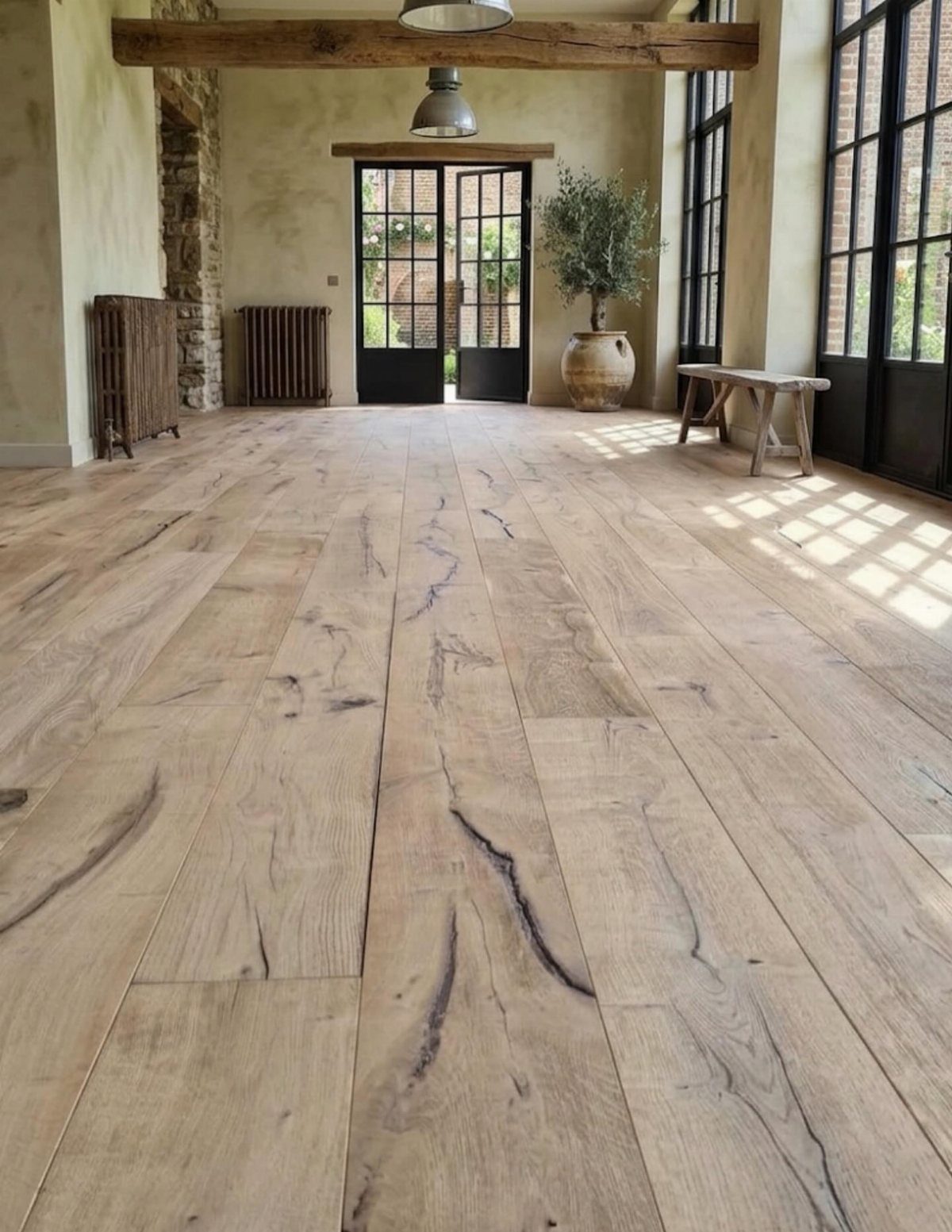
Natural oak carries more range than its name suggests. A single species can shift from near-white with cool gray drift, like Cloud, all the way to warm gold or even pink-leaning undertones in a grade like Galaxy.
Wide boards with the grain and knots left visible keep natural oak from reading sterile.
The task for a buyer is to sort the actual sample, not the species label. I would hold 3 oak boards against the wall color I already have and see which undertone wins out.
The wrong intonation turns "natural" into a fight with your sofa.
Mid-tone oaks with some knotting bridge old architecture and new floors without either one shouting.
3. Cool White Oak Wood Floors
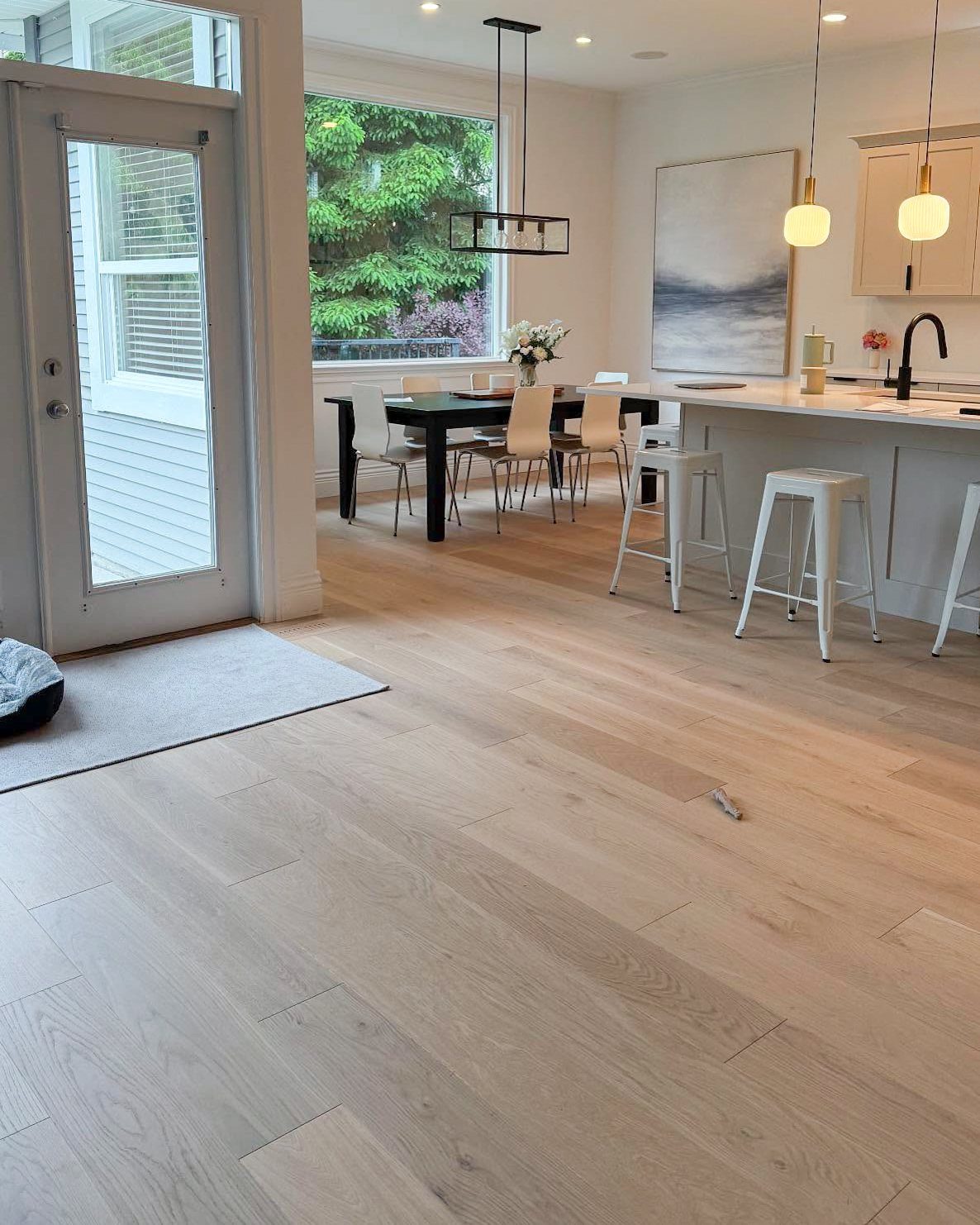
White oak engineered hardwood in a cool finish, like Anderson Tuftex Grand Estate Ashton Court at 3/4 inch by 10-1/4 inch, gives the broad plank scale that makes an open kitchen feel intentional rather than patched together.
Fewer seams across the sightline from island to dining table is what wider planks buy you.
Mullican Nordic Naturals Northern Lights, a 3/4 inch by 5 inch solid red oak, is the alternative if you want the same pale value in a narrower board and do not mind the softer species.
I would pick the engineered wide plank for a concrete slab or basement-level install, where dimensional stability matters, and save the solid 5 inch for a wood subfloor upstairs where nail-down is straightforward.
4. Cool Toned Wood Laminate on Stairs
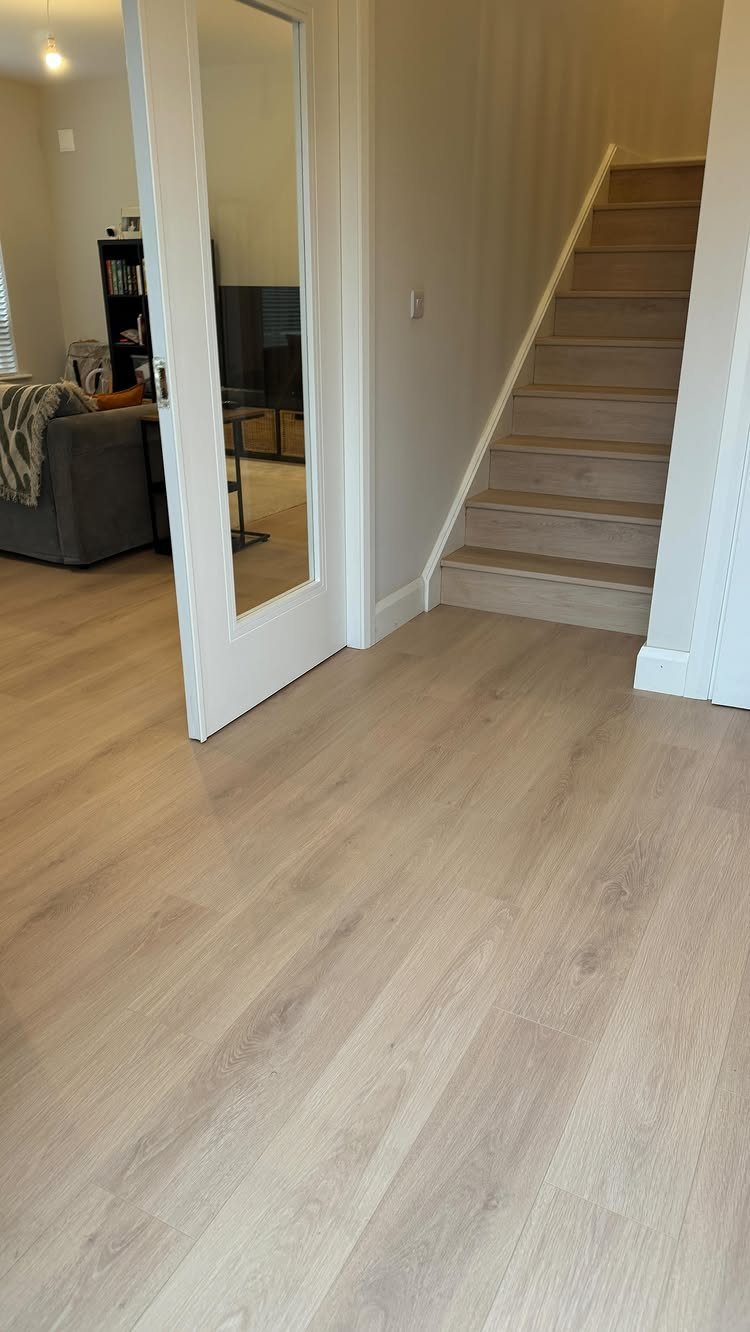
Running laminate up the stairs in the same cool tone as the hallway floor is a move that costs far less than hardwood on a staircase, but it lives or dies by the transition details.
The planks continuing straight onto the risers and treads works because standard laminate thickness does not bulk the nosing past where the door can still swing free.
What changes the answer is your existing stair geometry. If the treads are already worn uneven, laminate over them telegraphs every hump; a plywood overlay or replacement treads come first.
I would also check that the laminate brand sells matching stair-nose molding, because a site-built nosing rarely survives long under heel strikes.
For a rental or a first home you do not plan to stay in forever, this is the practical cool-tone route.
5. Cool Toned Floor Sample Testing
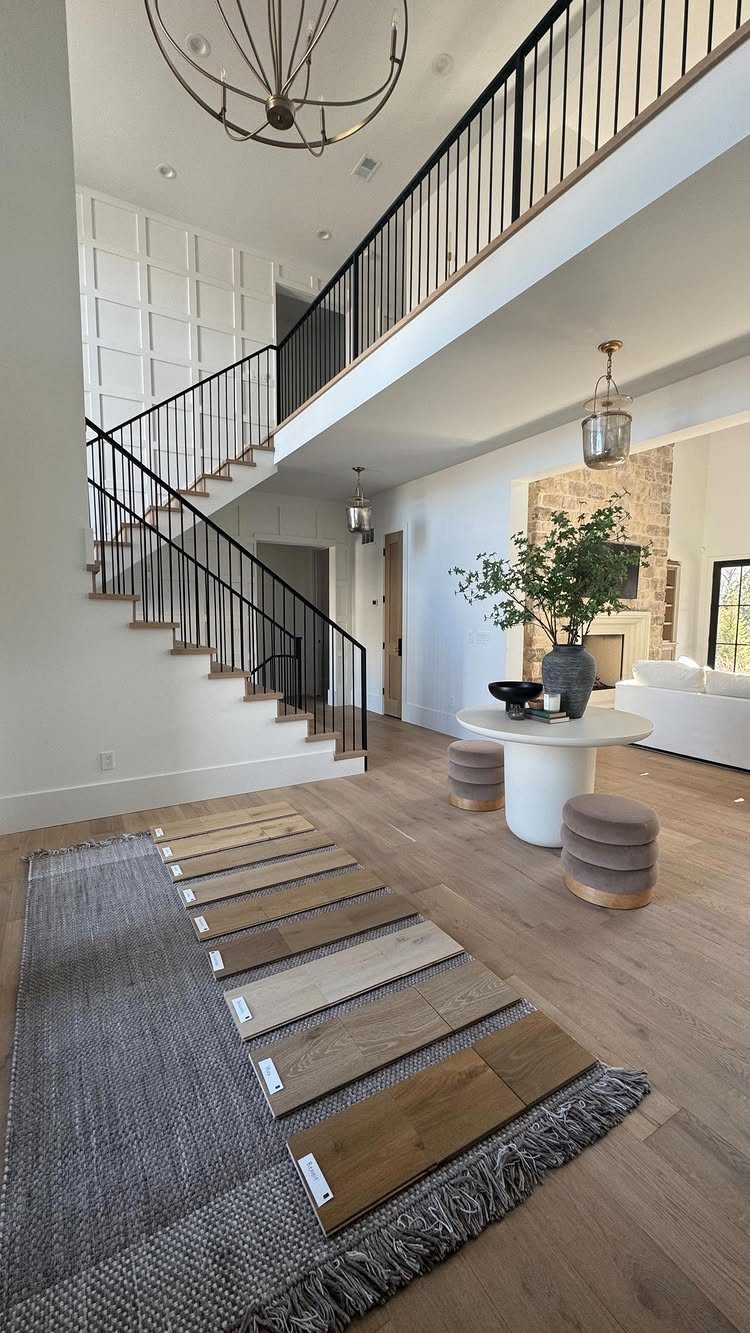
Laying samples on the actual rug, in the actual light, beats holding them under the store’s LEDs.
The method is several planks with their white labels still on, spaced across the grey woven surface so the eye can compare how each tone plays against the wall color and the existing floor.
I do this in morning, afternoon, and evening light, because a board that reads crisp by day can turn muddy by lamplight. A grey rug neutrals the background so the wood tones separate cleanly.
If one sample keeps winning across all 3 checks but you still hesitate, that hesitation is data.
It usually means the tone is right but the plank width or finish sheen is wrong, and you need a second round testing just that variable.
6. Ash Blonde Wood Flooring
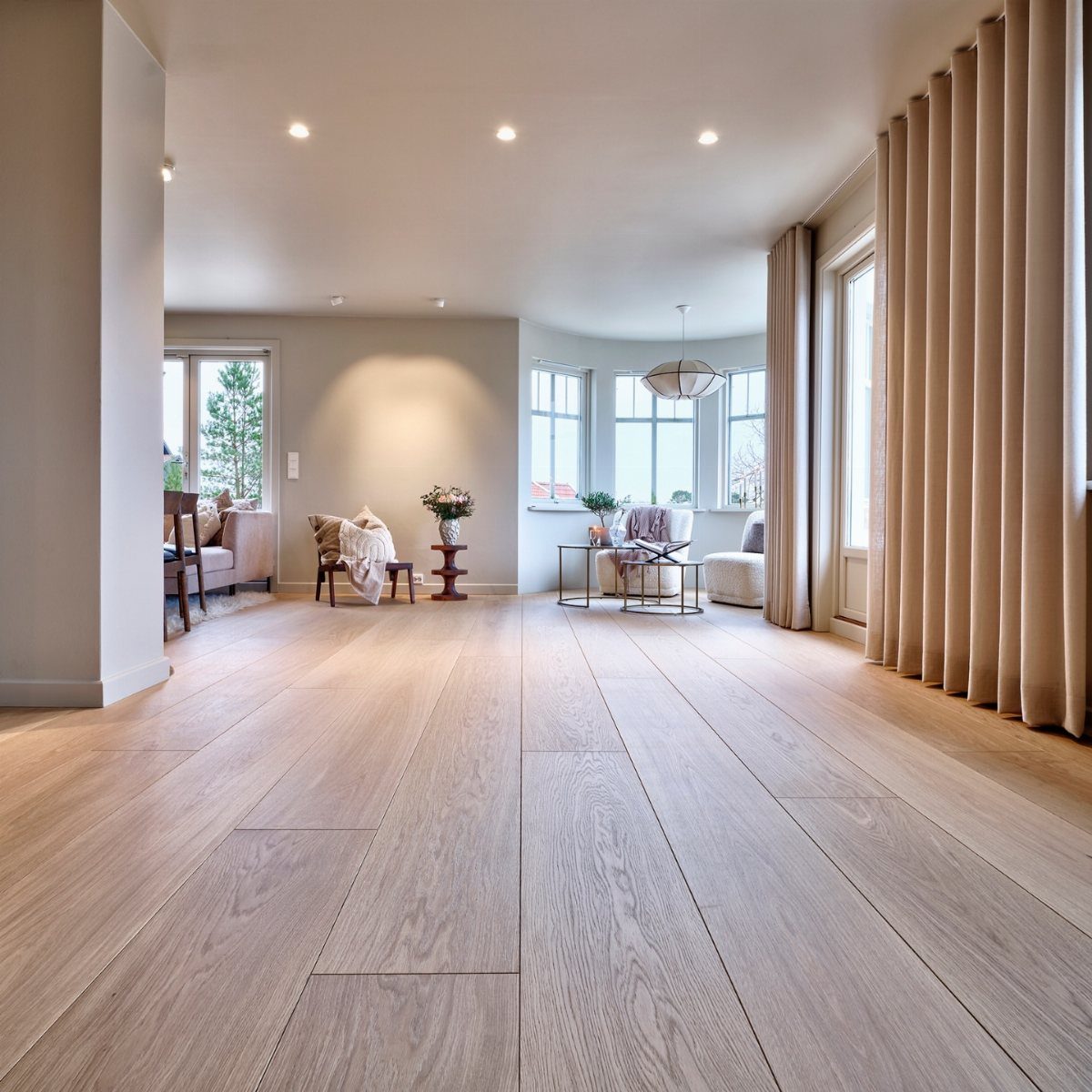
Ash blonde sits lighter than most greys but keeps enough cool drift to avoid the yellow cast that "blonde" can signal in oak.
In a room with generous daylight, beige curtains, and pale walls, ash blonde still holds its own tone instead of washing out.
I would call this the choice for someone who wants the room to feel larger and brighter without going all the way to a Scandinavian white floor.
Pale boards mean every dust particle and scratch shows, and the cool drift can read as tired rather than serene if the walls around it are already cool grey. Pair it with warm neutrals and it stays alive.
Impact of Wood Flooring Color
A floor color sets the temperature of a room before any furniture arrives.
Dark boards pull light in and close the walls, which reads as cozy in a large living room but can feel heavy in a space that already lacks windows.
Light floors do the opposite: they bounce daylight around and stretch the walls outward, which is why a small room reads larger with pale oak than with espresso walnut.
Gray sits between the two. It neither absorbs nor reflects aggressively, so the mood stays neutral and the eye moves to the sofa, the rug, or the wall color instead.
That makes gray-tone floors forgiving when you swap out decor every few years; the floor does not fight the new direction.
The risk is choosing a tone that clashes with what you already own. A cool gray floor against warm beige furniture can make both look dirty, like a photo with the white balance off.
Testing samples against the actual wall and upholstery, in morning and evening light, prevents that mismatch.
Maintenance of Wood Floors
Mid-tone woods earn their keep in a house that actually gets lived in.
Dust, pet hair, and the grit tracked in from outside all sit close to the average color of mid-tone boards, so the floor looks presentable for longer between sweepings.
Very light floors show every dark speck; very dark floors make pale lint impossible to miss within hours.
Scratches tell the same story. A dark stain sits on top of the wood, so any nick exposes the lighter wood beneath and that contrast pulls the eye straight to the damage.
Mid-tone color runs deeper into the plank, so minor scuffs from moving a chair or a dog’s claws blend in rather than shout.
This is not about avoiding maintenance entirely. Any wood floor needs regular cleaning.
But mid-tone buys you more time between sessions and forgives the small damage that accumulates in entryways, hallways, and kitchens. For a first home or a rental you plan to sell in a few years, that resilience matters.
Trends in Wood Flooring
Gray, light, and mid-tone woods are what manufacturers are pushing right now, and what installers are laying. The move away from very dark espresso stains and from flat, orange-tinged mid-browns has been underway for several years.
Cool tones in particular have shifted from niche to standard.
Gray used to be a specialty finish you hunted for; now every major line carries multiple gray variants, from the near-white drift of ash blonde to the slate depth of harbor mist. The undertone matters as much as the value.
A gray with green or blue drift reads different from one with violet, and the wrong drift against your wall color can make the whole room feel off.
Maple and white oak are the species most often finished cool, because their tight grain takes pale stains evenly without the blotching that red oak can show.
Birch and ash also appear in cool palettes, though less frequently in the big retail lines.
Visual Appeal of Wood Tones
The right wood tone does not just sit there; it works with or against everything else in the room. Warm floors against warm walls and warm furniture create a cocoon, which can feel rich or suffocating depending on the light.
The trick is not matching everything to everything.
Natural light changes the equation. A room with big south-facing windows can handle a warmer floor because the sun keeps the tone alive.
A room that relies on lamps and overheads benefits from a cooler floor, which reflects artificial light more evenly and keeps the space from feeling dim in winter.
When mixing wood tones in one space, pick one dominant tone and let the others play supporting roles. Too many competing woods turn the room into a furniture store floor.
Frequently Asked Questions
What wood has cool undertones?
Gray, blue, and muted taupe shades carry cool undertones in wood flooring. Maple reads light and creamy with a clean, fresh cast, while ash and birch sit airy and pale with enough gray drift to stay cool.
Ebony can also run cool when the finish pulls blue rather than warm brown.
What is the most popular wood floor color now?
Natural medium brown still leads overall, though gray and greige have climbed hard in recent years for modern homes. White oak, natural oak, and timber shades also rank high for their flexibility across styles.
Dark brown and greige sit right behind the mid-tone browns in current demand.
Is oak a warm or cool wood?
Oak can land on either side depending on the grade and stain.
Oak spans a wide range: the palest grades sit close to white with a gray cast, while others carry enough gold or even a faint pink to feel distinctly warm.
White oak tends toward the middle, neither warm nor cool, and a light stain will let that quiet grain stay neutral.